One Battle After Another: Living Beyond Disaster in Tallevast
Wilde Gallery · Williamstown · April 2026
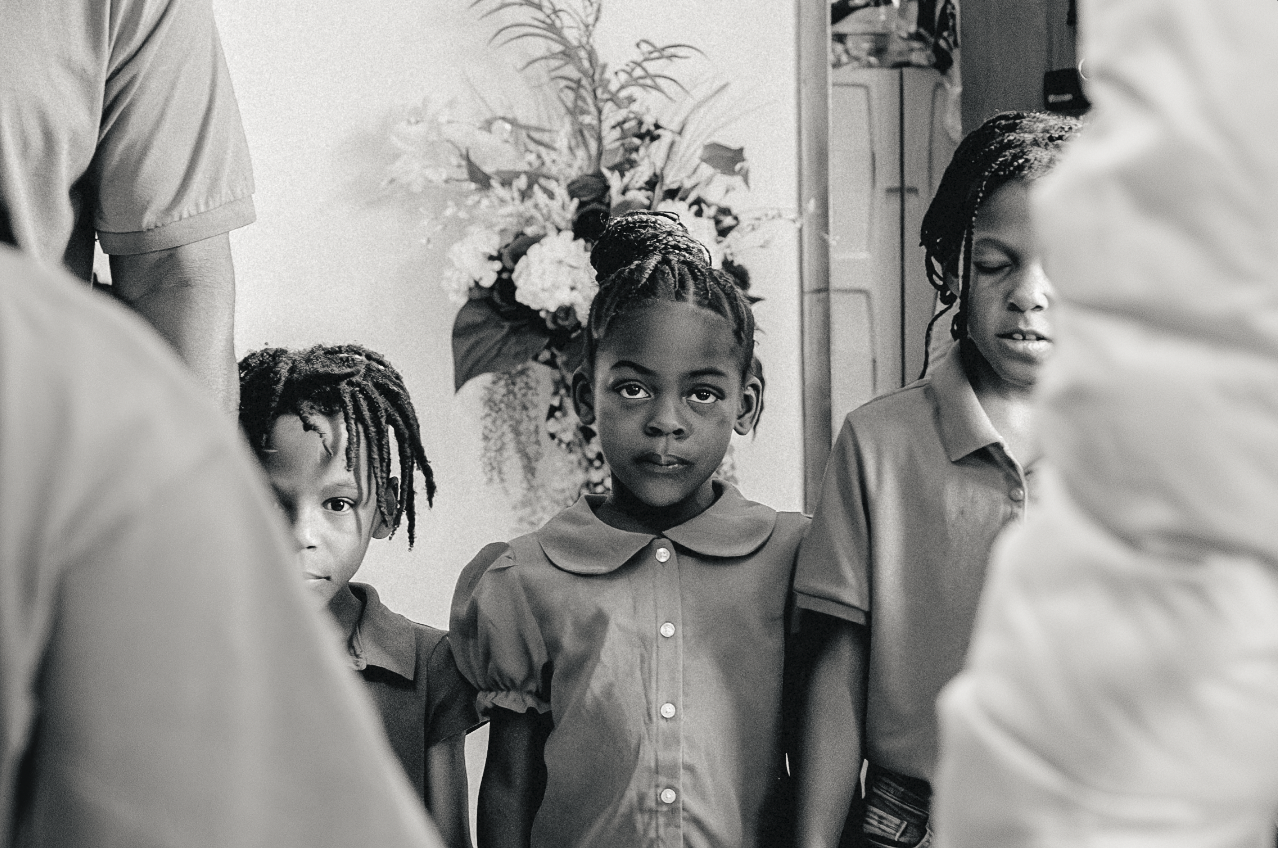
During the Cold War era, weapons manufacturers seized land adjacent to residents' property to erect an industrial plant to machine beryllium components. After the company polluted the groundwater with improperly treated organic solvents, state agencies knowingly withheld knowledge of the contamination from residents. Remediation of the pollution has only paved the way for new industries to replace the one that left poison in its wake.
Throughout it all, Tallevast community members have stood firmly, organizing for justice, repair, and a self-determined future. This student-organized exhibition compiles years of investigative projects by Williams students to bring Tallevast's story to a broader audience. It invites reflections on the failure of the state agencies to protect citizens, the collusion between government and multinational corporations, and the dynamic resilience of a community in the face of prolonged environmental racism.
Led Curators: Ziwei Lin'27, Beneyam Hassen'28.
Co-curators: Daniela Odong '28, Sara Fevrier '28, and Shiori Ono '28.
Funded by the Africana Studies Department and the Center for Learning in Action.
When Tallevast resident Beverly Bradley was asked about her hometown as a child, she answered without hesitation: it was the best place in the world.
The blissful peace at Tallevast was disturbed in 2003. One of its residents, Ms.Laura Ward, who later confronted Lockheed Martin and government authorities on behalf ofthe community through grassroot advocacy non-profit, F.0.C.U.S. encountered unidentified men installing a well in her backyard. One of the men indicated that it was not a well for water use, but a monitoring well due to the contamination that had been leaking from the American Beryllium Company site, since its operation in 1962. This was the first time that the community heard about the contamination, and it was four years after the county government was notified.
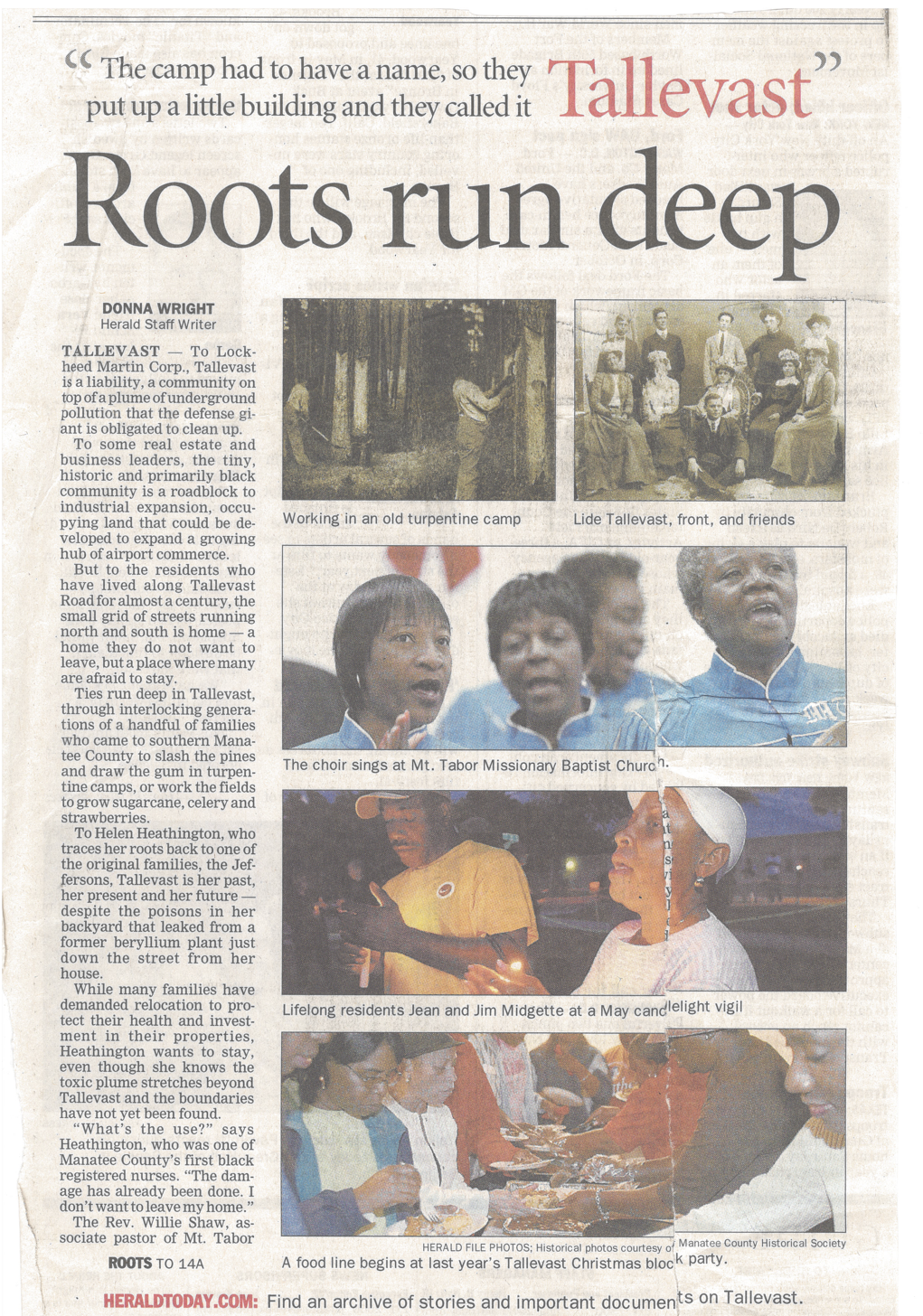
[LINK HERE] Courtesy of Manatee County Public Library's Historical Digital Collection. Catalogue number HRLFIC2024.73.1, titled: "History of Tallevast & it's Community".
Roots Run Deep: clip of newspaper article by Donna Wright. Dec 11th, 2005, part 1.
Founded by Black families who worked in turpentine camps and agricultural fields in southern Manatee County, Tallevast is a close-knit community whose roots span generations. For residents, it is more than a neighborhood—it is home, history, and identity.
Yet Tallevast now sits atop a plume of industrial contamination left by a former beryllium-processing plant, placing residents between attachment to place and concerns for their health and future. While corporations and developers often view the community as a liability or obstacle to expansion, many residents remain determined to stay, insisting that their ties to Tallevast run deeper than the pollution beneath it.
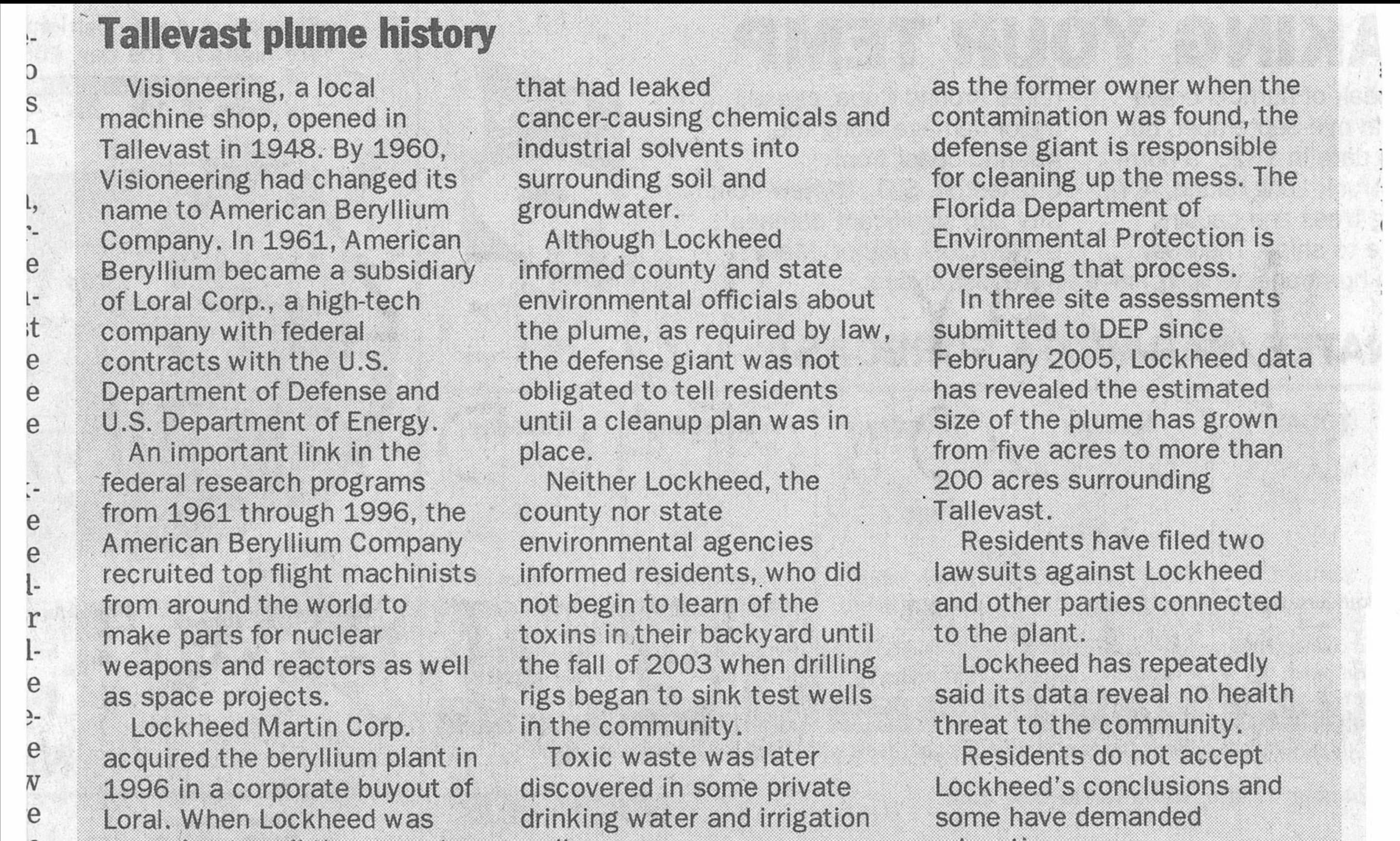
Tallevast Plume History
Beginning in 1948, a machine shop in Tallevast evolved into the American Beryllium Company, a key contractor for U.S. nuclear, aerospace, and defense programs. After the facility became part of Lockheed Martin in 1996, investigations revealed that industrial solvents and carcinogenic chemicals had leaked into the surrounding soil and groundwater.
Although environmental agencies were notified, residents were not informed of the contamination until 2003, when testing wells appeared throughout the community. As the estimated contamination plume expanded from five acres to more than two hundred, residents challenged official assurances that there was no health risk, filing lawsuits and demanding accountability, transparency, and relocation assistance.
One Battle After Another
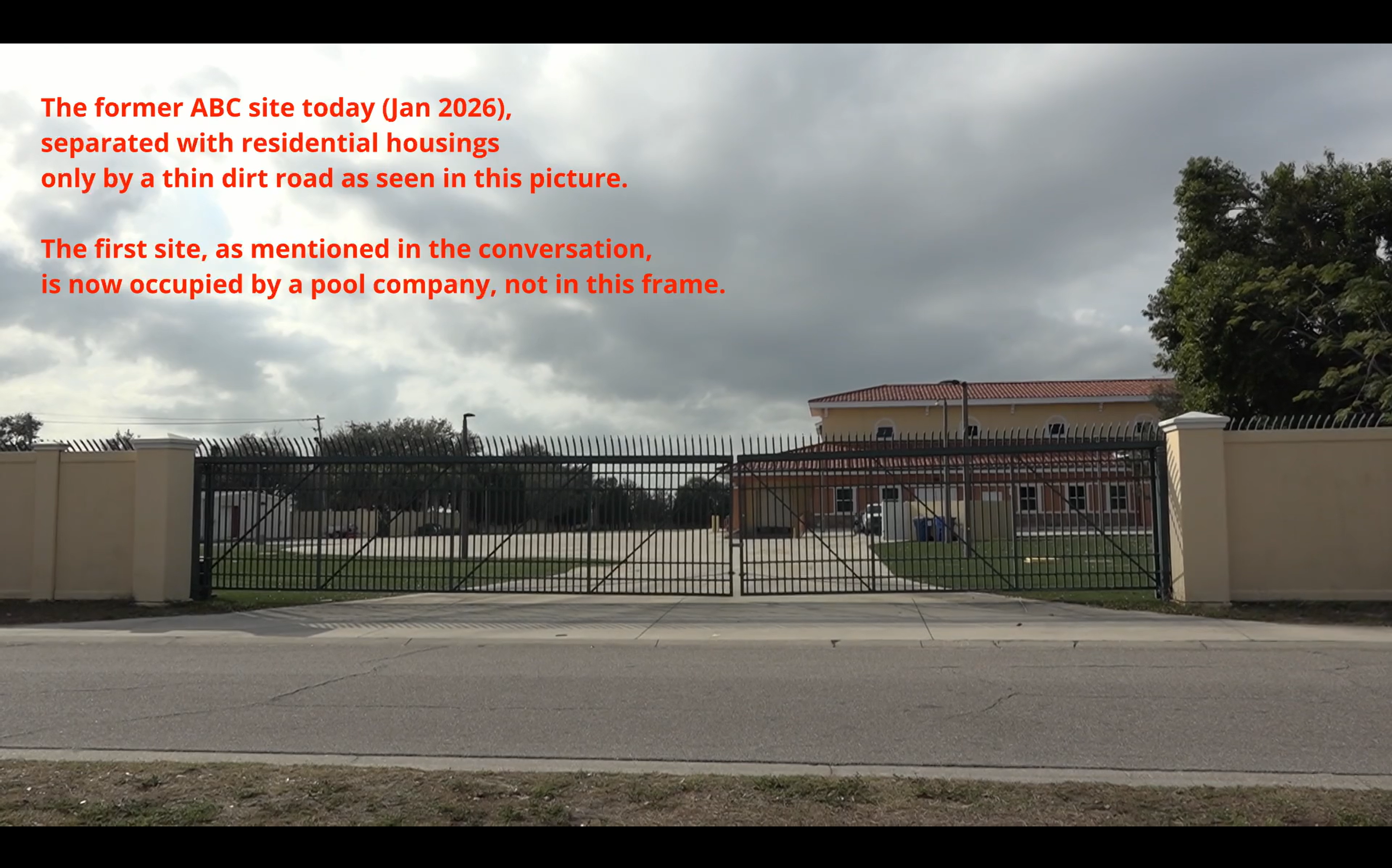
The former ABC site today (an 2026),separated with residential housingsonly by a thin dirt road as seen in this picture.
The first site, as mentioned in the interview with Beverley Bradley, is now occupied by a pool company, not in this frame.
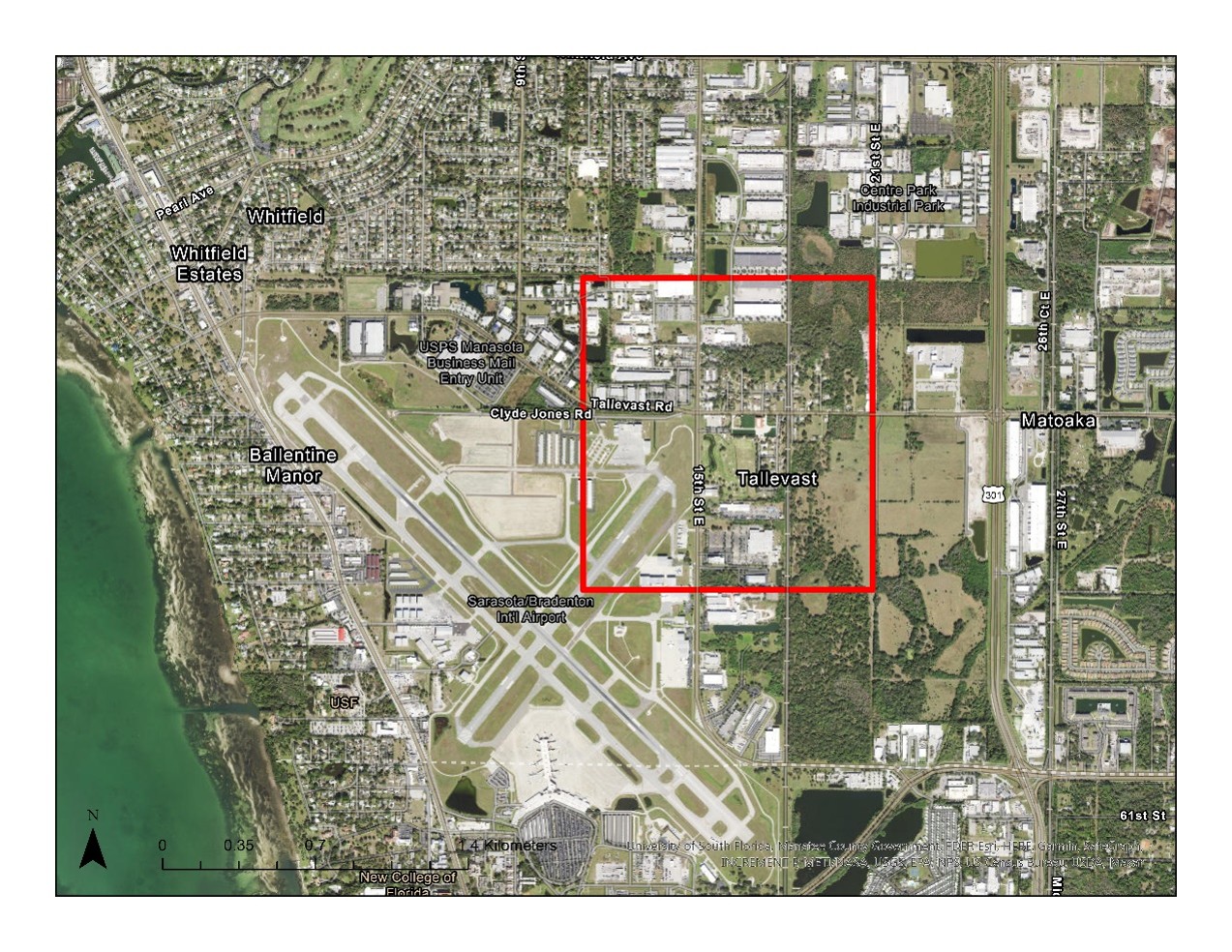
Map of Tallevast
Map locating industrial facilities and residential areas.
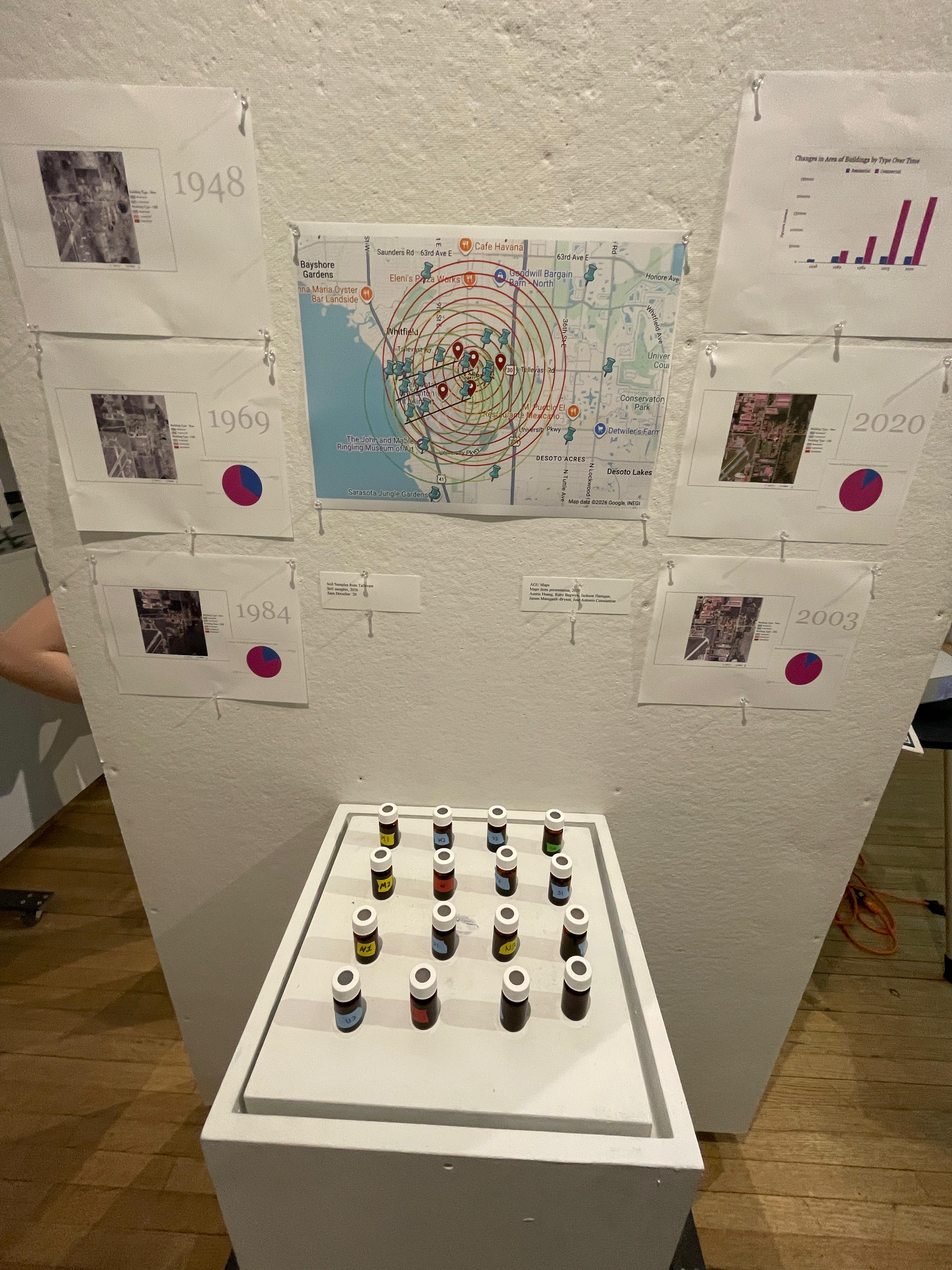
Material Evidence
The exhibition also included soil samples that Sam Drescher '26 collected in Florida for his senior thesis in chemistry, which quantifies chemical contaminants in the soil